
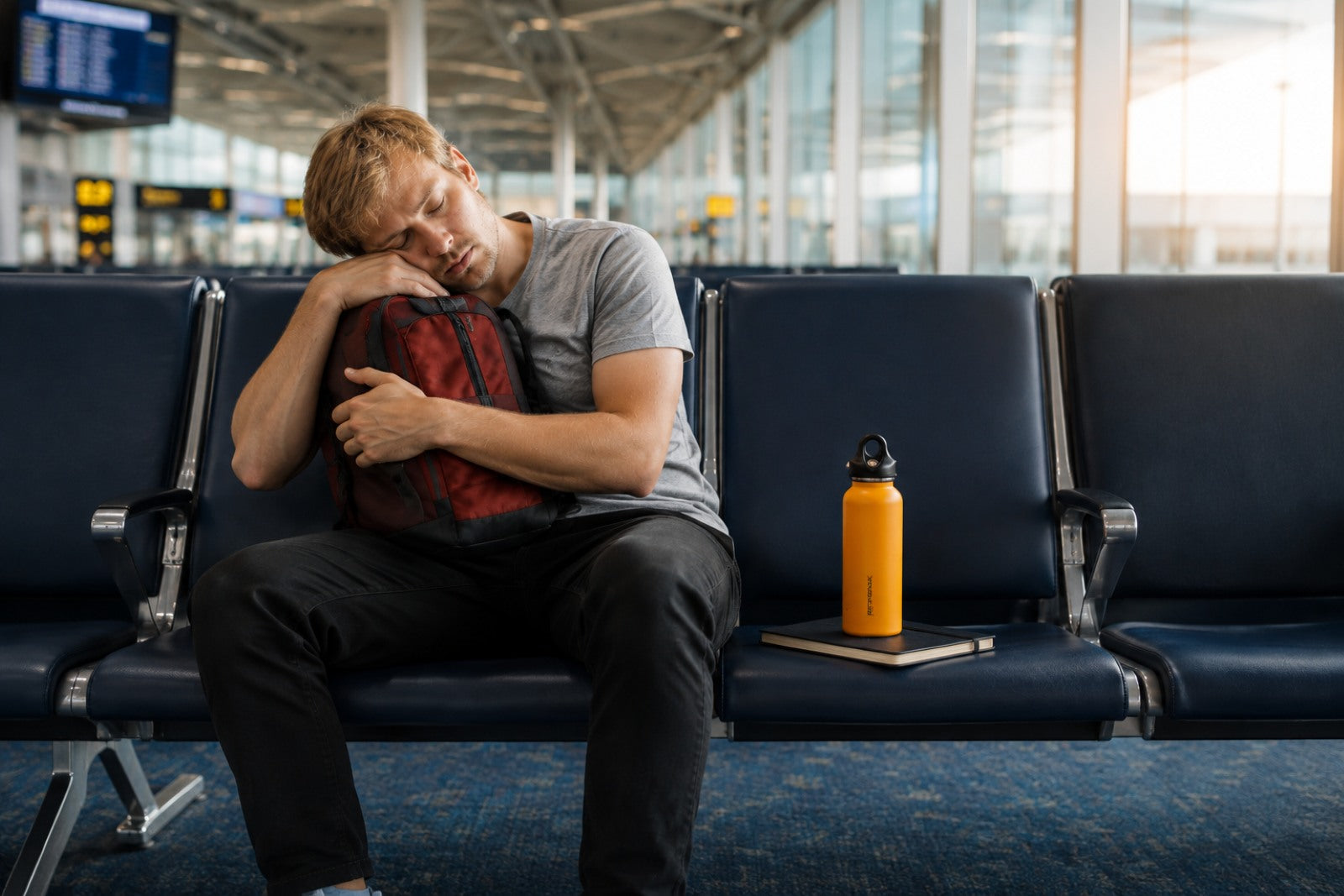
My work takes me around the world, which inevitably includes a lot of time flying on airplanes. I’ve been traveling like this for 15 years, and take more than 10 flights overseas annually.
Jet lag is a real thing, maybe not as much when you’re young, but definitely as you age. Technically, it is defined as when you travel across two or more time zones and it’s a real downer if you need to be your best for business meetings, or are trying to quickly adjust for a vacation with your family.
I don’t find a six-hour time difference to be too bad, but when I fly from the United States to Asia and it’s an 11, 12, or 13 hour difference, that becomes brutal.
You need to have a good plan on how to adjust, or you can face a week (or more) of bad sleep and low energy/exhaustion during the afternoons, which not only isn’t fun, but can become a liability when you have an important business meeting or need to go to the next “Instagramable” spot that your kids ABSOLUTELY need a photo at.
In general, my rule of thumb is to adjust by roughly two hours a day. So after a 12-hour time difference, I expect it to take about six days to feel fully adjusted. This approach has more or less has worked for me. But with a few of my science-backed strategies outlined below, you may be able to reduce jet lag even more.
1. Make Small Sleep Adjustments Before Departure
My schedule is usually packed whether I’m at home or on the road. But even with a jam-packed schedule, I try to make small adjustments to my bedtime and wake time according to the direction I am traveling a few days before departure.
If I am traveling east, I try to go to bed and wake up a little earlier than normal. Usually by an hour, but any amount can be helpful.
If I am traveling west, I shift both wake and sleep time a little later.
Mayo Clinic recommends gradually adjusting your schedule before departure and, when possible, moving your mealtimes closer to those you'll follow at your destination. I try this, but it can be tough with full workdays and a family with two young sons.
Starting a trip well rested can help with jet lag, but I know I struggle with getting enough sleep even when I am home and not traveling.
If I make a minor adjustment to sleep and wake times before I leave, I find that it does help on the other end and makes a little difference with combating jet lag.
Travel tip: When I board the plane, I change my watch to my destination's local time. It tricks my brain and gets me in the mindset of when I should be sleeping, eating, and staying awake at my final destination.
2. Go Out into the Light
If there's one jet-lag strategy worth understanding, it's light.
Your circadian rhythm responds strongly to light and darkness. Light influences your body's production of melatonin, a hormone involved in regulating your sleep-wake cycle. That's why properly timed exposure to daylight can help your internal clock adjust after you've crossed time zones.
Once I get to my destination, I like to go outdoors to expose myself to natural light, especially if I land during daylight—natural light is key to help your body clock adjust. The Mayo Clinic offers tips on when and when not to expose yourself to light, depending on the number of time zones crossed and direction you fly.

I used this strategy when I recently traveled overseas for business for two weeks. The 15-hour flight over, and the multiple flights and time zones I crossed during my trip gave my internal clock a run for the money.
Since I flew west from the United States to Asia and I was landing at night local time, I tried to stay up during a good portion of the flight so that I would be dead tired on arrival and be able to have a good first night’s sleep. If you’re able to stay up the entire flight, more power to you, but I find that taking a short nap (two hours) can tide me over so that when I get to my destination I’m decently tired, but not absolutely exhausted.
Travel tip: If you have an important meeting, event, race, or activity soon after arrival, consider arriving a day early when practical. Giving your body extra time to adjust may be more effective than trying to power through severe jet lag.
3. Stay Hydrated Before, During, and After Your Flight
As the co-founder of a water bottle company, hydration is obviously important to me. Being hydrated doesn’t reset your circadian rhythm, but it can make an exhausting travel day feel less horrible.
To combat the low humidity in airplane cabins, and the wear and tear of travel on my body, I make hydration a key part of my travel routine.
Before the flight: On the day of the flight, I try to drink an entire 20 or 32-ounce bottle of water before I get to the airport or board the flight. That way, I can start my trip hydrated rather than trying to catch up later.
I bring my own bottle and ensure it is empty before going through security and then refill it with water when I’m through the line and headed to my gate. And yes, in case you are wondering, TSA does allow you to carry a water bottle.
If you’re traveling internationally, some airports will now allow you to bring full water bottles through security as long as they’re using advanced EDSCB (Explosive Detection Systems for Cabin Baggage) 3D scanners.
The airports where this is currently allowed are London Heathrow, London Gatwick, Birmingham, Bristol, Bournemouth, Edinburgh, Belfast International, Dublin, Milan Malpensa (Terminal 1 only), Rome Fiumicino and some others around Europe.
Hopefully, this technology can be approved in U.S. airports soon as I always thought it was a waste to throw perfectly good water away.

During the flight: I keep my water bottle handy, and sip water regularly instead of waiting until I’m noticeably thirsty. Most flight attendants will give me a refill if I ask.
To change things up, I normally drink sparkling water instead of still, but it’s up to your own personal preference.
Our Revomax bottles can handle the pressure from carbonation, whether in the air or on the ground. So the bottle doesn’t spit back at me when I open it in the airplane cabin from the pressure or have the cap be screwed in so tight that it requires superhuman strength to open up again.
After arrival: I will try to drink another full water bottle after I land. This helps me transition to the local climate better so I don’t start the trip playing catch-up on hydration.
Travel Tip: If you bring an empty, reusable insulated bottle with you when you travel, you can keep cold water with you throughout a long travel day rather than depending entirely on beverage service.

4. Be Strategic About Sleep, Caffeine, and Alcohol
Travel can be stressful. Health experts recommend limiting both caffeine and alcohol because they can make jet lag worse. Mayo Clinic advises using caffeinated beverages carefully and avoiding caffeine later in the day when it could interfere with sleep. Think of caffeine as a tool, not a substitute for sleep.
From my experience, I take different approaches depending on if it’s during the flight or after I arrive at my destination and where I’m flying to.
Flying westbound
I drink caffeinated beverages during the first few hours of the flight so I don’t oversleep. My drinks of choice are a Coke Zero or Diet Dr. Pepper. I do not drink coffee or tea during arrival service as it is typically late afternoon or nighttime when I am landing.

Sometimes a nightcap before can be helpful, but this may depend on how your body reacts to alcohol. Personally, I have been avoiding alcohol three hours before bed because I have discovered that as I age, alcohol doesn’t give me restful sleep.
While it allows me to nod off pretty quickly, alcohol tends to wake me up after three to four hours and then I have trouble falling back asleep. I definitely didn’t have this problem when I was younger.
I generally avoid alcohol on the plane as it causes dehydration. However, it’s not the end of the world if you have one drink with your main meal right after takeoff. Just remember that the more you have fun during the flight, the more you might regret it later after arrival.
Ultimately, you know your body the best, so make your own decision on whether or not alcohol is helpful to your rest.
Flying eastbound
I avoid caffeinated beverages completely and often skip the dinner service as well so I can sleep more. Flying to Europe from the East Coast is typically an overnight flight of six to seven hours, and you arrive early morning in Europe.
If you take into account the time for taxiing, take-off and landing prep, it means you’re going to be getting 5-6 hours of sleep at most. So in this situation, avoid caffeine and alcohol in the early part of the flight. HOWEVER, I do have a cup of coffee (or tea) during arrival service so that I have enough “energy” to power through the day and make it to nighttime in Europe before crashing for a good night’s sleep.
I avoid alcohol completely on the plane, but may have some during the day when I land in Europe depending on the situation. So for example, I don’t drink if I plan on walking a ton seeing sights during the summer heat, but if I’m by the beach, yes, having a mojito is quite relaxing.
Travel Tip: Try to sleep during the flight if it is nighttime at your destination. I put on an eye-mask and noise-canceling headphones (some airlines also provide ear plugs), cover myself with a travel blanket and get as comfortable as possible. I skip the meal if it is an evening or overnight flight and try to zone out to adjust to the destination time zone.
5. Start Living on Local Time When You Arrive
Once I land in my destination, I start following the arrival city schedule. I try to avoid daytime sleep if possible, and time meals according to local time.
If I arrive in the morning, that may mean staying awake until an appropriate local bedtime. One of the main things I try to do is get outside and walk around. Hydrate. And use daylight strategically to tell my internal clock that the day has begun.
Light exercise really helps. If you’re in Asia, movement during the afternoon will help you power through the worst time of the day when your body is telling you it’s time for sleep, generally between 3 to 5 pm local time.
When nighttime arrives, I give my body every possible signal that it's time to sleep: dim the lights, put away bright screens, make the room comfortable, and try to go to bed at a reasonable time.
Most importantly, I recommend avoiding screen time before bed. I like swiping through Tik Tok just as much as the rest of the world, but the constant flood of video and sound isn’t exactly conducive to letting your brain know that you’d like to sleep.
Finally, if you get up in the middle of the night to use the restroom (ahem, something else that happens as you age), whatever you do, DO NOT look at the clock. If you do, I guarantee you’re going to start thinking.
As soon as you start thinking about things, whether it is the next day’s business meeting or what sights you’re going to see, you’re going to have a heck of a time trying to fall asleep again.
Use the restroom, avoid turning on the main lights (night light features in hotels are there for a reason), and get back to bed and try your best to just zone out so you can fall asleep again. It may take 30 minutes or an hour, but don’t give up. Even if you don’t fall asleep, your body can get some rest.
Travel Tip: While sticking to the local schedule is best practice, listen to your body. If you absolutely must sleep, try to just take a short nap. The CDC recommends keeping daytime naps to about 20 to 30 minutes, since longer naps can make it harder to sleep that night. Personally, I find that even a short nap really can make me feel a little better and ready to explore my new destination or engage in a business meeting.
Final thoughts
Have realistic expectations! You’re not going to be getting a full eight (or however many) hours of sleep the first few nights at your destination. The first night you may be exhausted and sleep for 12 hours, but the next few nights you may only sleep for five or six.
But whatever you do, try and get to six total hours of sleep at night. You’ll eventually move back to your regular overall hours as your body adjusts. Sometimes with jet lag, it isn’t the first night that is tough, it can be the second night, after the adrenaline of travel has passed. But don’t worry. If you get off track, you can just repeat these tips until you feel better.
A Simple Long-Haul Flight Jet Lag Checklist
Before departure:
- Be intentional about getting good sleep in the days leading up to your trip.
- Gradually shift your bedtime toward your destination's schedule when practical.
- Begin your trip well hydrated.
- Pack an eye mask, earplugs or noise-canceling headphones, and an empty reusable water bottle.
During the flight:
- Change your watch or phone to destination time.
- Drink water regularly.
- Limit excessive alcohol and caffeine.
- Sleep if it's nighttime at your destination.
- Stay awake when practical if it's daytime there.
- Get up periodically to stretch and move around the cabin.
After arrival:
- Begin eating and sleeping according to local time.
- Get appropriately timed daylight.
- Continue hydrating.
- Avoid a long daytime sleep if you're trying to adjust to local nighttime.
- Give yourself extra adjustment time before an important event whenever possible.
Frequently Asked Questions About Jet Lag

What causes jet lag?
Jet lag occurs when rapid travel across multiple time zones causes your internal circadian clock to become misaligned with the local day-night schedule at your destination. Symptoms can include trouble sleeping, daytime fatigue, difficulty concentrating, changes in appetite, and gastrointestinal problems.
Is jet lag worse flying east or west?
For many travelers, flying east is more difficult because it requires the body to advance its internal clock—essentially falling asleep and waking earlier than usual. Mayo Clinic notes that eastward travel can be harder than westward travel.
Does drinking water prevent jet lag?
Not by itself. Jet lag is primarily caused by circadian disruption, not dehydration. However, airplane cabins have low humidity, and dehydration can contribute to some symptoms associated with jet lag. Staying hydrated before, during, and after a flight is therefore a useful part of a broader jet-lag strategy.
Should you sleep on a long-haul flight?
It depends on the time at your destination. If it's nighttime there, sleeping during the flight can help you begin adapting to the new schedule. If it's daytime at your destination, staying awake when practical may make the transition easier.
Does sunlight help with jet lag?
Yes. Light is one of the most important signals regulating your circadian rhythm. Properly timed light exposure can help shift your internal clock toward your destination's schedule. The ideal timing depends on your direction of travel and the number of time zones crossed.
The Bottom Line
You can't always prevent jet lag completely, particularly after crossing many time zones. But you can make the transition easier.
Start adjusting before you leave. Use daylight strategically. Stay hydrated. Coordinate sleep and caffeine with your destination's schedule. And once you arrive, start living on local time.
After all, you took the long flight to experience somewhere new—not to spend the first few days feeling like your body is still somewhere else.
Travel well. Stay hydrated. Enjoy the ride.
One-Second Summer: Revomax Launches Beverage Bottle That Opens with One Hand in Under One Second